From Teq63 as a character to collaborations that serve as platforms for extended creativity
When I ring the doorbell to Burnwater Studios and ask about Quiccs, I peek through the door and it doesn’t look like anything I expect. I know of Quiccs Maiquez through the figure that he started making in 2012 and that has brought him international renown, Teq63. So I expected to see a roomful of them.
Later, as we walk around, Quiccs will explain to me that pre-pandemic this room would’ve been filled with artists creating designs for Burnwater clients. But now it’s mostly empty, with artists working from home. Most of this afternoon, talking and seeing the inner workings and aspects of the enterprise, things aren’t exactly as I expect, but often surprising and joyful.
I am taken from this first room to another. And later to others. By the end of the afternoon I come to understand that rather than one large office, there’s a network of rooms spread across the floor of the office building.
Enter one room and it’s a repository for merchandise that’s to be sent out, move to another and there’s striking artwork and rare toy designs, and yet another is a conference room. Push past what feels like a hallway, and revealed is a special workdesk where yet to be released collabs are hidden from easy view.
This interconnected network of rooms begins to make sense as I keep talking to Quiccs. I’m ostensibly here for this interview because of the new tech-related collaborations he has. But I am also here to learn how he thinks, and how that thinking guides his creativity in building what could arguably be considered a toy empire and what might be my own generation’s remix on art collecting.
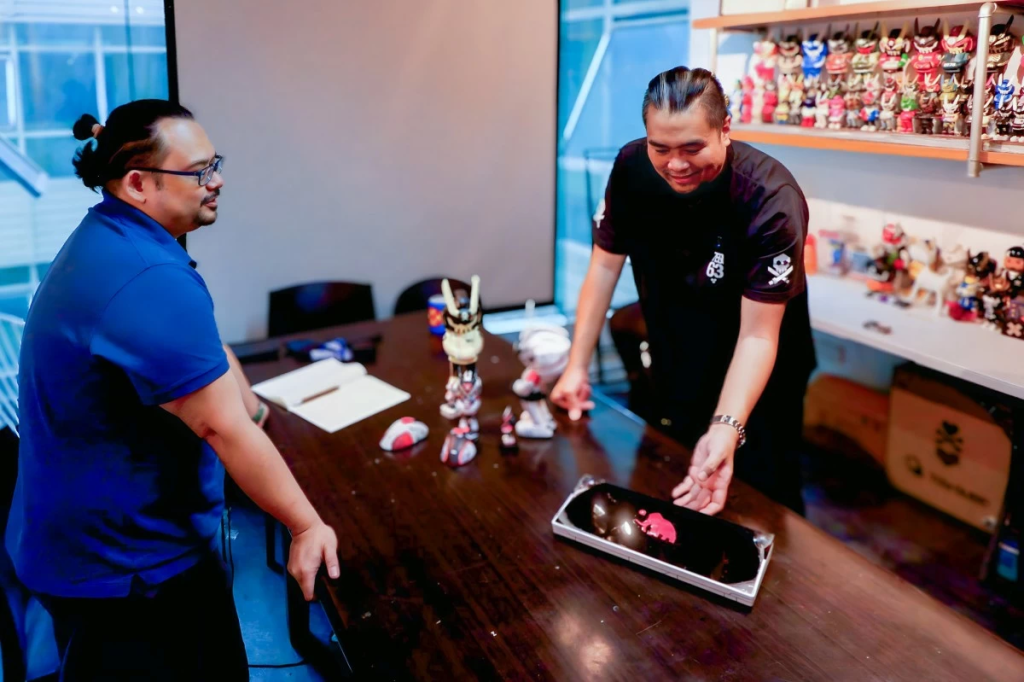
“I like portable gadgets.” Quiccs explains further, “things that unfold, they transform or become bigger.” He points me to the FMG9 submachine gun, which is the kind of weapon he has chosen to equip Teq63 with. And he shows me the design of the Balisword, the Filipino balisong filtered through the Quiccs-design aesthetic that captures the original essence of the knife while adding a layer of mecha-cool onto it.
Before the interview, I, like many who may not have met Quiccs, could easily spot some of the influences in Teq63’s design, particularly that influence of the design aesthetics of mecha and tokusatsu, of things that look like they could interlock or expand and turn into something new. Talking to him I understand more about both the design and his approach to his designs as well as his collaborations.
I look at the Teq63s on the desk, standing between us, their hands shoved into the pocket of their hoodies, the chests puffed up and the backs arched. “Ang angas talaga niya, no?” I observe, and Quiccs laughs, says that’s part of the character. It’s that swagger, taken from hip-hop and graffiti art, the come-at-me-bro-ness of a Teq that other toys might struggle to emulate or altogether shy away from.
The “angas” in the design of the core toy concepts has moved across collaborations, such as Johnnie Walker, Adidas, and Jollibee. I get to see it in play with the Mammoth75 keyboard, created with their partner Zion Studios. Quiccs points out the elements that they’ve had a hand in, particularly the design touches, color, and overall feel that make it seem like a serious, hefty keyboard. This isn’t something for your everyday typing, but directed specifically to lovers and collectors of mechanical keyboards. Each keyboard also comes with its own Teq63 designed specifically to match it; the toy having a retro-gaming feel.
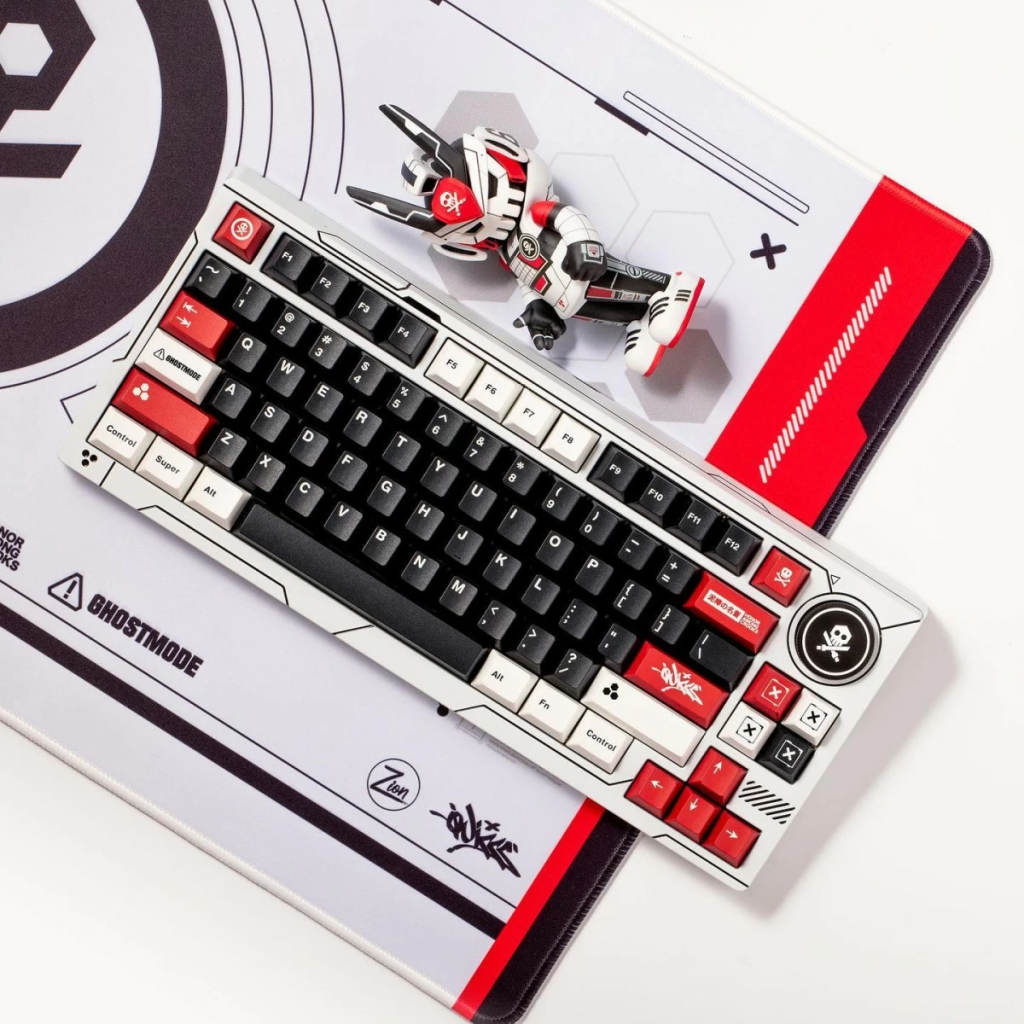
In the hands, the Mammoth75 keyboard is surprisingly heavy. It’s a substantial chunk of metal and the mecha/industrial aesthetic isn’t just visual, but part of the art object design. One design element that calls attention to itself is the knob on the keyboard’s top right, that both is a press-button and rotates, and is assignable. Quiccs explains to me that it reminded him of a record on a turntable and I fiddle with it, imagining scratching a record and having this fun thing to increase or decrease my computer volume.
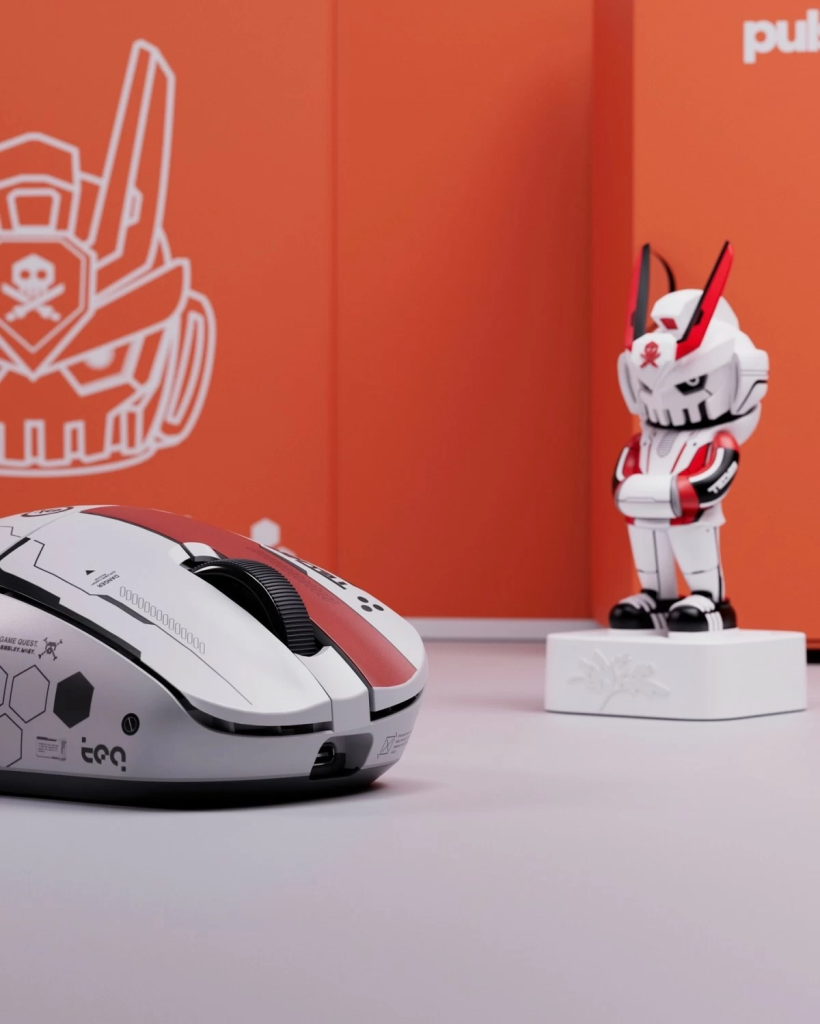
Similar in its art object aspirations and shipping with its own commensurately smaller Teq63 is the Pulsar Mouse. While its form factor feels similar to most other products in class, its visuals put it in a class of its own.
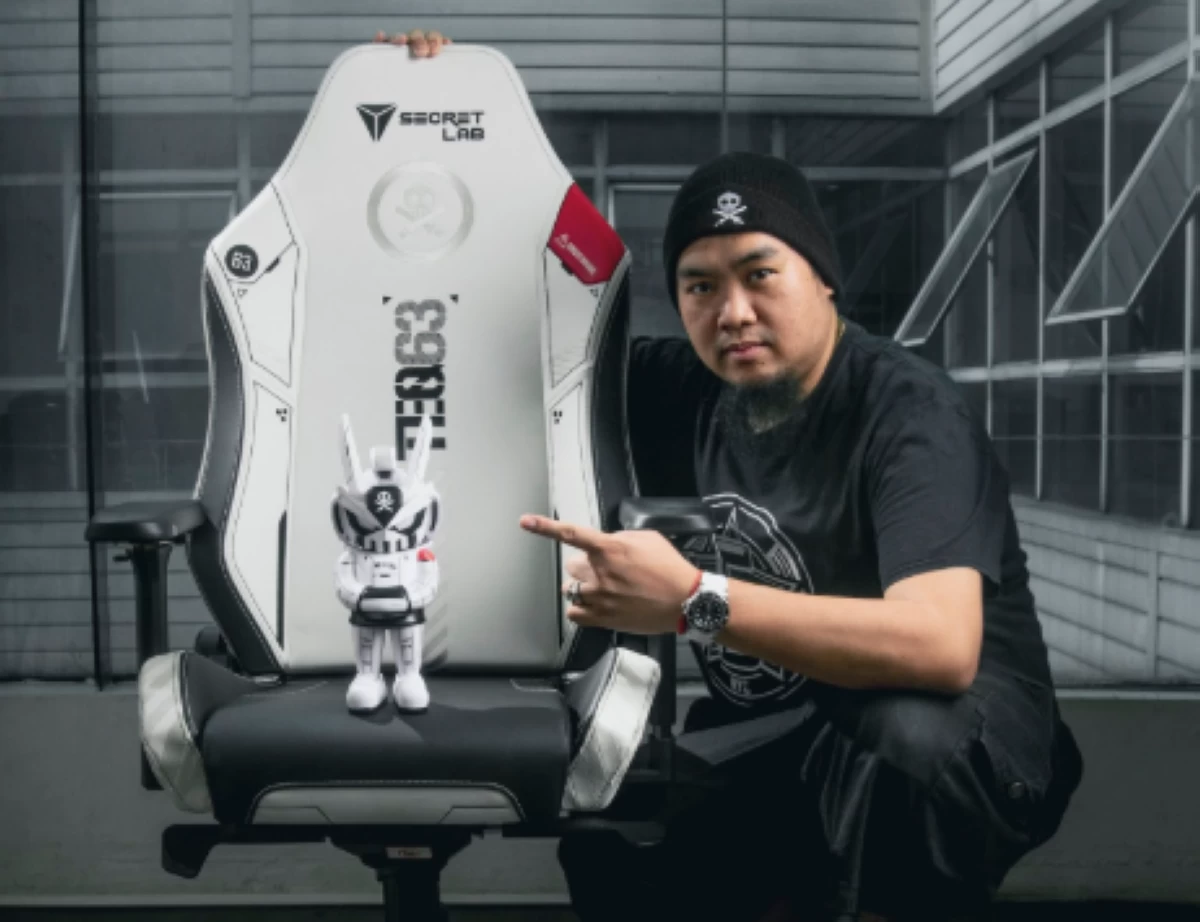
To complete if you were trying to build a Quiccs-designed workstation is the Secretlab x Quiccs chair. Quiccs explains to me that the founder of Secret Lab had been a fan of his designs, and when the chance to collaborate came along, both parties were excited. Further he says that he doesn’t approach collaborators, but trusts that the right opportunities and partners will approach.
Between the gaming chair, the keyboard, and the mouse, you would spend six figures to pull that set together. I imagine how cool it would be though, sitting in my own cave, sunk into the chair, hammering away at the cold metal of that keyboard. It makes me wonder if Quiccs is using heavy-duty gear to help him design new things. So I ask, what do you use on the day-to-day to plan out toys and other art?
“iPad mini lang.” Again a moment of surprise. And then I’m impressed. Quiccs explains that if he drops a smaller device on his face, sketching while in bed, it doesn’t hurt as much as a full-sized tablet. We both laugh. Then he pulls out his phone and shows me sketches and his artistic process.
“It’s Procreate on my phone and iPad.” He walks me through the layers of design he can use to plan both small work like figures, as well as large work like murals. He explains to me that he goes to what helps him capture things fast, and then build out the ideas.
The idea of, from small things, large ideas, large executions come. From these small rooms, small devices, small teams, these small toys, come larger ideas of representation, identity, expression, and art. I note how Teq63 is a character and a platform. Quiccs has said it’s a representation of him. I offer the idea that he provides a platform where he and the collector meet, he offers himself in the form, and then the collector adds their own taste with the choice of which Teq63 to collect.
One of the final rooms Quiccs takes us is just full of toys. This is the kind of room I had expected to see at the start. And yet, it’s filled with surprise because there are toys of familiar characters, things that 80s and 90s kids grew up with, but interpreted in new ways. Quiccs hands me a toy that unfolds, I slide a hinge and it transforms into something else and for a moment I am transported, in the way that a good toy can, in the way a piece of art can.